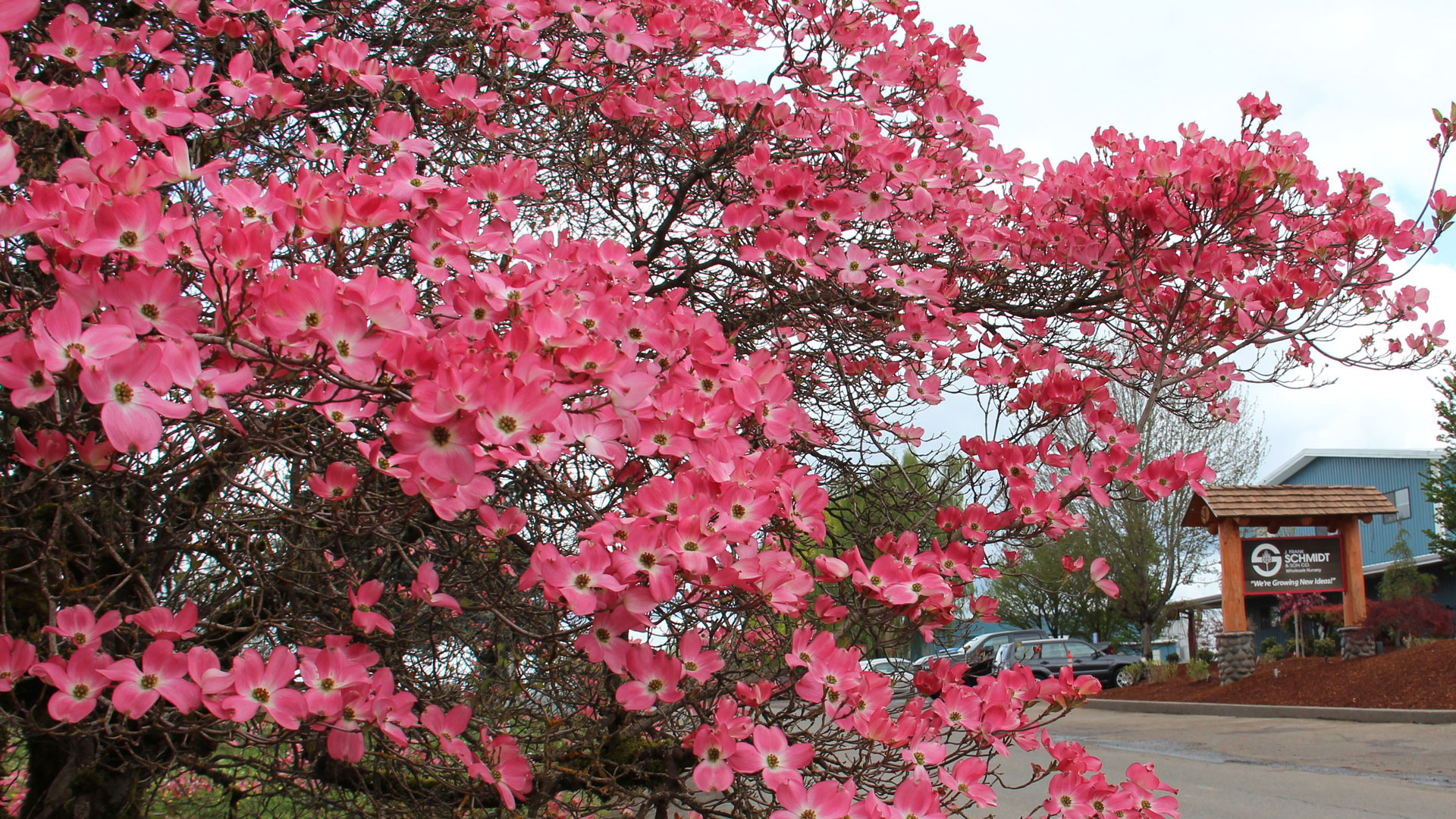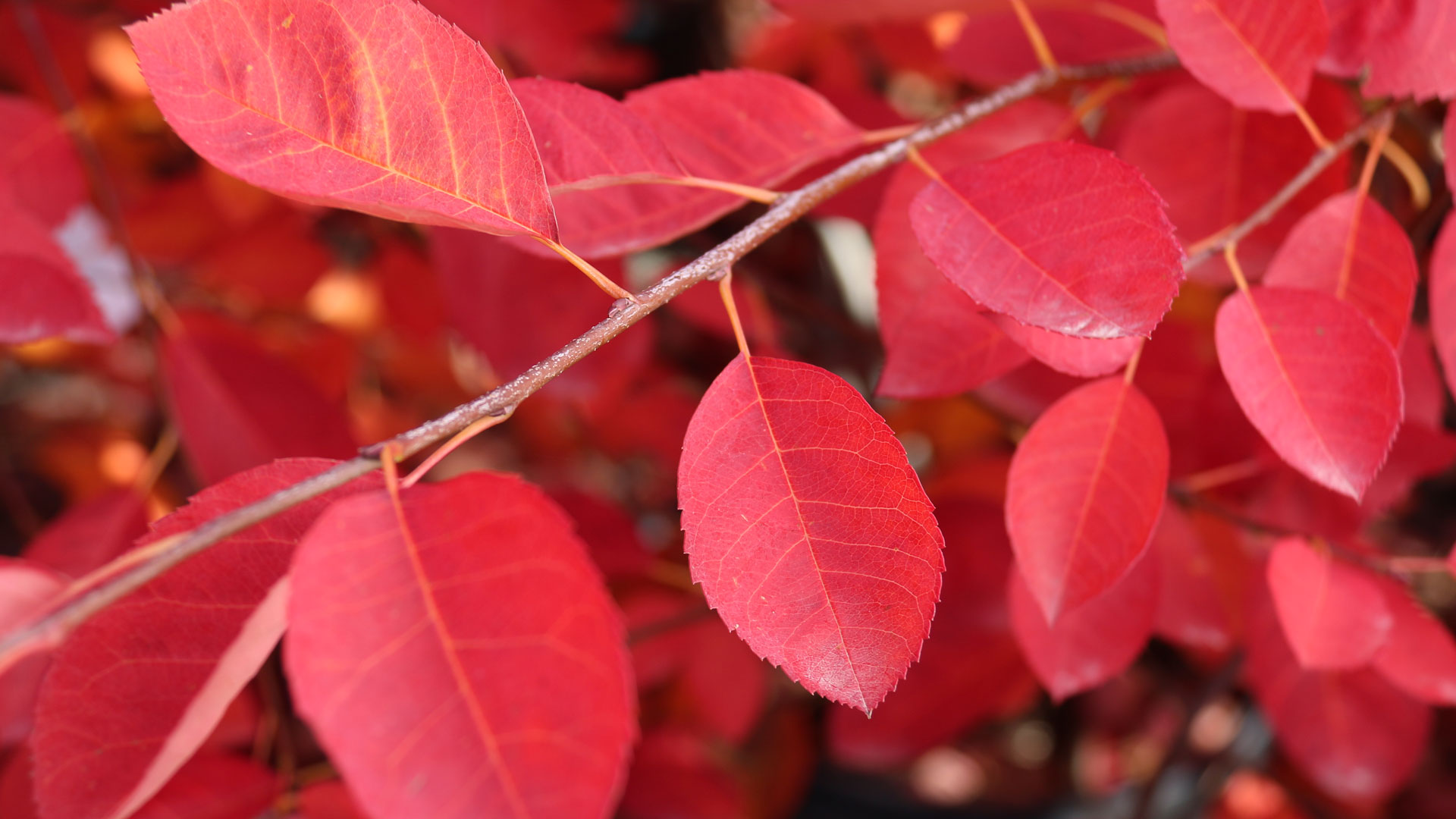
Dogwoods provide dazzling beauty from tiny bract to full bloom in spring to green lush shade foliage in summer to rich fall color. Constant change through the seasons is a delight to watch! Dogwood bracts have the advantage over typical flowers in that they are more substantial and sturdier…extending the spring color show to several weeks and sometimes up to a month with the bracts remaining on the tree while the leaves begin to emerge. Branches tend to be elegantly layered and broader than height with age. Bark develops beautiful mosaic patterns of grays, khakis, and warm tans as it exfoliates with age.
Dogwoods come in a wide variety of colors, bract size and shape, size and branching habit. Two of the most popular ornamental dogwood species are Cornus florida or Flowering Dogwood, native of North America with emarginate (indented) bracts in May-June, smooth red oblong fruits in early fall and red/purple autumn foliage, and Cornus kousa or Kousa Dogwood, native of Japan, China, and Korea with pointed bracts forming a distinct start shape in April-May, with unique matte red round edible bumpy fruits and elegant orange to purple fall color. Cornus Kousa is more disease resistant and hardy than its C. Florida counterpart. Reasonably cold hardy in USDA zone 5 and 6, best grown in neutral to acidic well drained soils. These incredibly diverse trees are a must-have in the urban garden, as a specimen in a public park, or in small landscapes. Check out the unique cultivars below!

New for 2026!
Cloudburst™ Dogwood
Developed by Dr. Tom Ranney of North Carolina State University this exciting new tree is an exceptional, fast-growing dogwood with particularly large and showy white bracts. A unique triploid hybrid of C. florida and C. kousa, it has disease resistant foliage that tuns a spectacular combination of yellows, oranges, and reds in the fall.
USDA Zone 5.

Prairie Pink Dogwood
Soft pink flowers cover the tree in spring and give way to thick glossy leaves that resist the tough climate of the plains. Selected at Kansas State University as a top performer for the Great Plains.
USDA Zone 6.
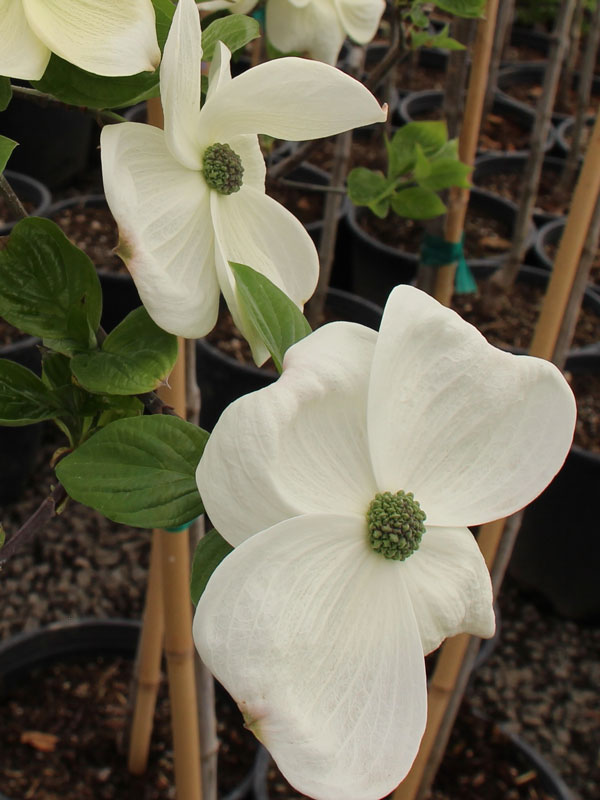
Eddie’s White Wonder Dogwood
White flower bracts of this hybrid cultivar are much larger than those of its parent C. florida, and it grows taller. It is also easier to grow and more adaptable that its other parent, C. nuttallii.
USDA Zone 6.

Cherokee Brave Dogwood
The most vigorous of the pink flowered dogwoods, this cultivar shows resistance to both powdery mildew and spot anthracnose. Well branched in the nursery, it is impressive for its size, deeply colored foliage, and bloom.
USDA Zone 5

Summer Fun Dogwood
With brighter white leaf margins than those of other variegated dogwoods, the Summer Fun Dogwood is delightful visual spectacle in all seasons. White flower bracts of late spring complement rich, boldly contrasting green and cream-white leaves. In late summer the cream gently turns to blush pink then to a vivid red orange in the fall with the green centers deepening to dark maroon.
USDA Zone 5

Stellar Pink® Dogwood
Large and slightly overlapping flower bracts are tinted a delicate shade of soft pink, a little lighter in color than C. florida rubra. Flowering date of the Rutgers series is intermediate between the C. kousa and C. florida parents.
USDA Zone 6.
Looking to purchase a J. Frank Schmidt & Son Co. cultivated Dogwood? You can use our Retailer Locator to find Schmidt customers near you who may have just what you’re looking for.